
The missing middle: US LFP CAM capacity
Can the U.S. build a compliant LFP cathode industry before Section 45X sunsets?
For decades, Chinese industrial policy in batteries has been consistent, patient, and coordinated. State capital has been effectively directed into maximising global share of upstream resources while heavy investment into technical excellence has created a dominant position in midstream production. By 2025 that policy had produced a battery supply chain in which China supplied around 98% of global lithium iron phosphate cathode active material (LFP CAM). U.S. policy, by contrast, has arrived in cycles. The 2022 Inflation Reduction Act catalysed more than US$120bn of committed EV and battery investment through a suite of consumer, manufacturing, and investment credits. The 2025 One Big Beautiful Bill Act (OBBBA) then pruned the demand side while preserving manufacturing (45X) and investment (48E). Section 232 followed in January 2026 with a proclamation on processed critical minerals and their derivative products, pointing toward negotiated allied price floors backed by the US$12bn Project Vault stockpile. The design shifted from broad demand stimulus to targeted “carrot and stick” policy, with protections at the border and subsidies on the factory floor.
How did the U.S. build the cell but miss the cathode?
This policy stack has worked well on the downstream. According to REA data, U.S. lithium-ion demand grew almost 25% year on year in 2025 on the strength of battery energy storage system installations accelerating from AI-infrastructure needs, with domestic cell capacity responding. LG Energy Solution’s Holland, Michigan plant produces LFP for storage at commercial scale; Lansing is due to mass-produce in H2 2027 anchored by a US$4.3bn Tesla Megapack 3 offtake; Ultium Cells’ Spring Hill facility is retooling from EV NMC to LFP for storage in Q2 2026; and Ford’s Marshall, Michigan plant is starting LFP production. LG Energy Solution has publicly estimated a total conversion cost of more than US$1bn across five of its North American plants. That the company is willing to invest is a measure of how compelling the ESS demand signal has become, and of the role 45X now plays in the near-term operating economics of U.S. cell manufacturing. In REA’s view, Advanced Manufacturing Production Credits (45X) have been a meaningful contributor to reported margins at the leading Asian cell makers’ North American operations in recent quarters, and continued access to them shapes ongoing investment decisions.
OBBBA’s decision to preserve 48E for storage through 2033, alongside the accelerating build-out of AI data-centre capacity, has locked in the demand side of the pivot. Hyperscalers are running into drawn out grid interconnections, with delays extending 4-7 years in some major U.S. load centres and are deploying behind-the-meter battery storage at scale to bridge the wait, firm intermittent supply, and ride through grid faults. The result is a structural pull-on U.S. LFP cell capacity that did not exist two years ago, with significant investment into domestic production matching the market opportunity.
Why hasn’t 45X delivered the cathode plants?
The problem sits one link up the chain. Every LFP cell built in the U.S. still requires cathode active material, and there is essentially no compliant LFP CAM being made in the country. This leaves U.S. cell makers exposed to long and fragile foreign supply chains which, on the basis of discretionary retaliatory duties, have faced volatility in the final delivered cost since Liberation Day tariffs were announced. In REA’s view, by 2030 the U.S. market will face a structural deficit of roughly 68,000 to 230,000 tonnes per year of FEOC-compliant LFP CAM, equivalent to between two and eight standard 30,000-tpy cathode facilities. Global compliant supply is thinner still. Of the roughly five million tonnes of LFP CAM capacity expected worldwide by 2030, only around 6.5% sits under 25%-or-less Chinese ownership. The nominally “Western” LFP CAM projects in Morocco, Indonesia, Finland and Spain are majority-owned by Chinese partners and dependent on Chinese process technology and precursor supply, which puts their 45X eligibility for U.S. off-takers in doubt.
US Gap Analysis for compliant LFP CAM
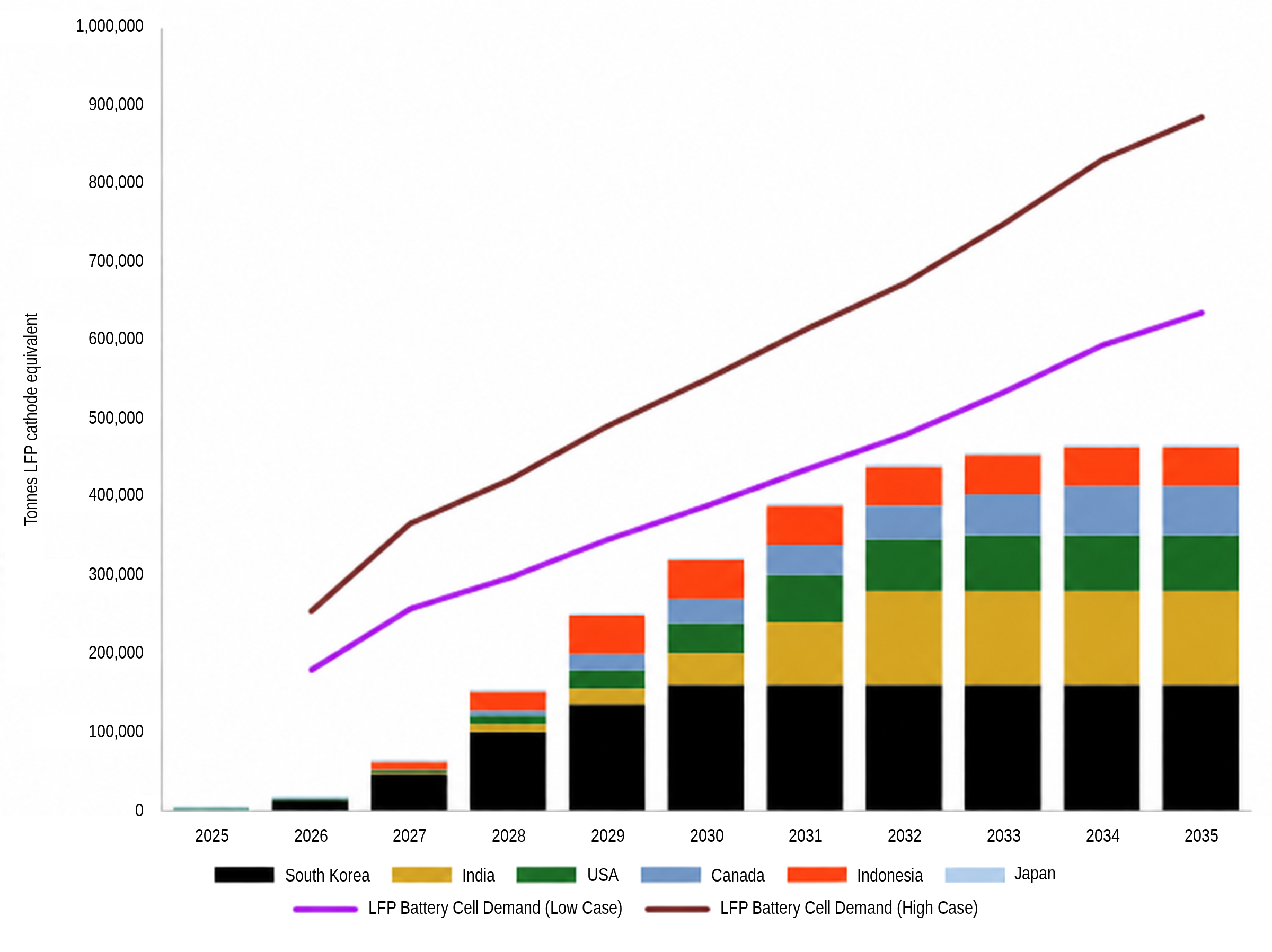
The window of opportunity for building solutions to this growing structural gap in the U.S. is closing. A U.S. cathode plant can take 2-4 years to design, permit, and build. With Section 45X credits phasing down from 2031 and sunsetting at the end of 2033, U.S. projects still in the planning phase may only capture one full-value year of 45X before the taper starts. The credit was designed to underwrite a new industry’s operating economics. But the industry now cannot reach first production inside this window. That, more than any single technical or cost issue, is why announced U.S. LFP CAM capacity remains negligible despite an otherwise attractive incentive structure. In the view of REA, a targeted extension of Section 45X for cathode manufacturing, with the credit sunset pushed later into the 2030’s, paired with accelerated federal and state permitting, would materially improve the arithmetic for an established cathode maker considering a U.S. site.
Exploring the integration play, the localisation in a state with upstream lithium at scale, competitive industrial power costs, existing brine-handling infrastructure and a transparent, stable royalty regime further de-risks the road to commercialisation. Arkansas meets these criteria. The Smackover Formation hosts up to USGS-estimated 19.0 million tonnes of lithium. ExxonMobil’s Saltwerx unit, the Standard Lithium–Equinor Southwest Arkansas project) and Albemarle’s Magnolia operations sit within a decades-old bromine industrial cluster with pipelines, disposal wells and central processing already in place. The Arkansas Oil and Gas Commission’s 2.5% brine royalty, set in May 2025, is the first standardised lithium royalty framework in the country. Co-location of a compliant LFP CAM facility with domestic carbonate production shortens logistics, closes the mine-to-cell loop and, if paired with an extended and appropriately targeted 45X, gives an incoming cathode operator the timing certainty the current sunset does not.
The window of opportunity for building solutions to this growing structural gap in the U.S. is closing. A U.S. cathode plant can take 2-4 years to design, permit, and build. With Section 45X credits phasing down from 2031 and sunsetting at the end of 2033, U.S. projects still in the planning phase may only capture one full-value year of 45X before the taper starts. The credit was designed to underwrite a new industry’s operating economics. But the industry now cannot reach first production inside this window. That, more than any single technical or cost issue, is why announced U.S. LFP CAM capacity remains negligible despite an otherwise attractive incentive structure. In the view of REA, a targeted extension of Section 45X for cathode manufacturing, with the credit sunset pushed later into the 2030’s, paired with accelerated federal and state permitting, would materially improve the arithmetic for an established cathode maker considering a U.S. site.
Keen to dig deeper? Stay ahead of the market with REA
Related Insights

- Batteries
- Batteries
- Batteries