The LGES/Lopal deal highlights the urgency with which US LiB makers feel they must respond to fast rising demand for ESS cells. They cannot wait for fully ex-China LFP CAM supply chains to be built; instead, they must work with existing options and try to adapt these in the short-to-medium term to stay compliant with sourcing rules.
LG Energy Solution’s decision to sign a three-year LFP cathode active material (CAM) supply framework with Chinese producer Lopal Tech—capped at up to Rmb27bn (~$3.8bn) through 2028—is the latest reminder of how hard it is for western firms to cut themselves off from Chinese expertise in the LFP CAM space.
The volume of material involved speaks to the rapid growth of LGES’s ESS order book and the company’s underlying expectations for that market in coming years. LGES reported that ESS revenue was almost five times higher y/y in H1 2026, having previously said it had accumulated more than 140GWh of ESS cell orders. Meeting those orders requires a significant increase in LFP CAM volumes in the near term.
To understand the magnitude of LGES/Lopal deal, it is worth translating the financial ceiling into physical cathode volume and finished cell capacity. With LFP CAM pricing generally trading in the range of Rmb40-60k per tonne ($5.9-8.9k per tonne, depending on specifications and high-compaction premiums), an annual ceiling of Rmb9bn equates to roughly 150-225kt of LFP CAM per year—or somewhere between 450,000 and 675,000 tonnes over the full three-year contract period.
In manufacturing terms, standard LFP cell production consumes about 2,400t of CAM per gigawatt-hour (GWh). At those conversion rates:
- 150-225kt of CAM translates to approximately 60 to 90 GWh of LFP cell capacity each year.
- Over the three-year term, the full Rmb27bn allocation could support roughly 180-270GWh of cumulative LFP battery production.
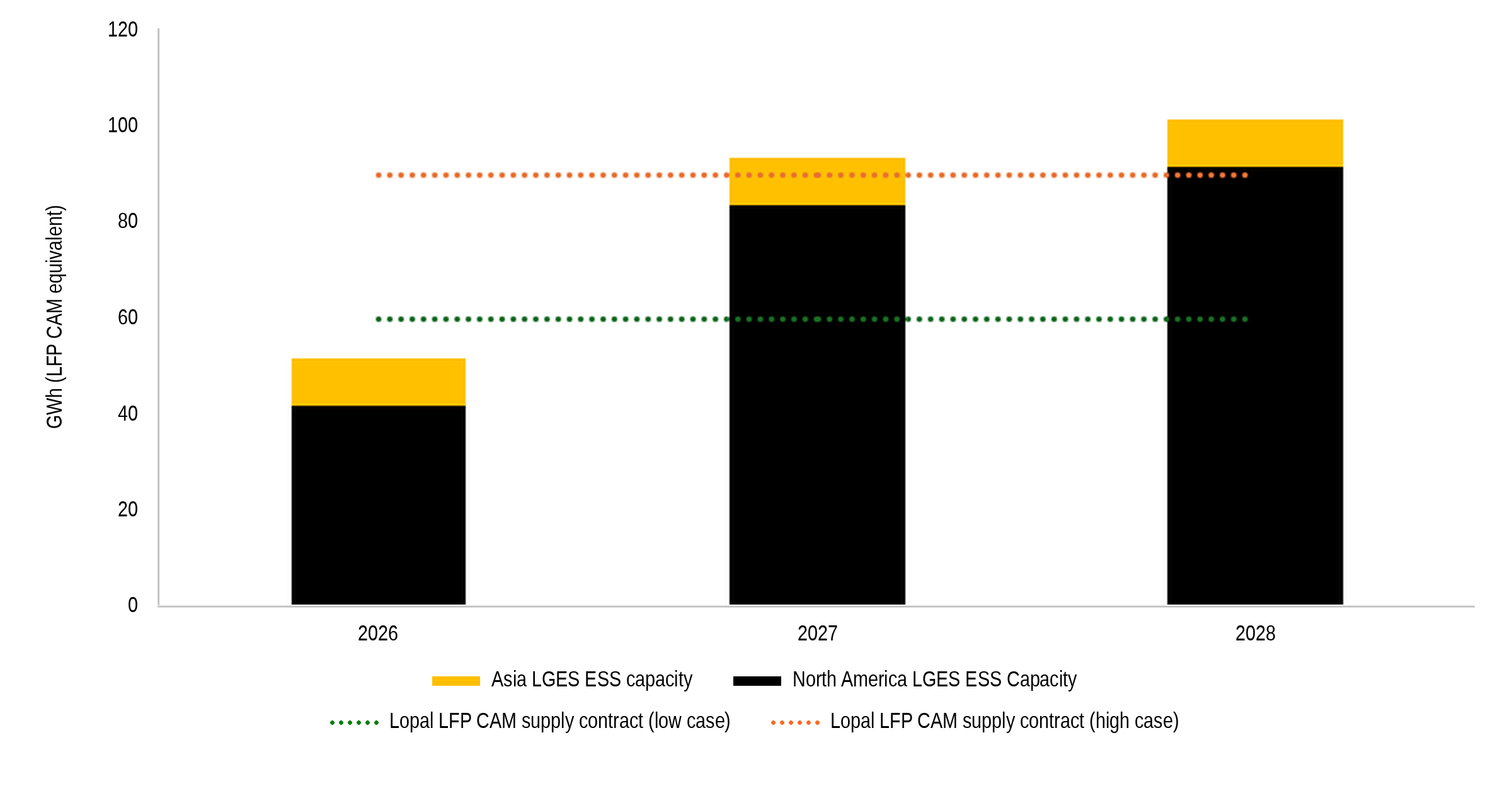
To what extent will this cover LGES’s needs? The bulk of LGES’ planned ESS cell making capacity will be US-based. Having retooled plants in Michigan, Arizona, Tennessee and Canada, the company is targeting around 50GWh of LFP ESS cell capacity in North America this year. REA estimates this could rise to roughly 90GWh by 2028, which would be covered by the high-case estimate of CAM-equivalent volume under the Lopal agreement. LGES also has an LFP ESS cell footprint in Asia—currently around 10GWh per year—but this is not expected to grow at the same rate as US-based capacity in coming years.
LGES has not publicly announced any LFP CAM offtakes with suppliers other than Lopal. The implication of this is that a sizeable proportion of LGES’s LFP CAM needs in the USA will be met by Lopal through the end of 2028. LGES’s decision to double down on its relationship with Lopal reflects a lack of alternative options. South Korea’s domestic cathode leaders—EcoPro BM, L&F, and POSCO Future M—have begun setting up domestic LFP lines. But their commercial-scale output remains nascent and their cost structures unproven. The only other alternative would have been for LGES to vertically integrate LFP CAM from scratch, which would absorb substantial capex and require years of process optimization—time the company does not have as it converts production lines in North America.
LGES’ LFP CAM agreement with Lopal seems intended to cover much of its demand requirements through to end-2028, most of which will arise in the USA
In Lopal, LGES has an established Tier-1 producer capable of delivering immediate scale and without the need for capex investment. Furthermore, Lopal is among the few producers offering mature 3rd and 4th generation high-compaction LFP (with powder densities topping 2.45–2.50 g/cm³ and >2.6g/cm³, respectively). These advanced materials provide the higher tap density, cycle life and cell-level voltage uplift required to meet performance standards demanded by utility BESS operators and fast-charging vehicle platforms. (NB: Lopal Indonesia is apparently only offering 2nd and 3rd generation LFP CAM due to China’s technology restrictions, which prevent the latest, “state-of-the-art” variants from being produced outside of China.)
It has not been stipulated where Lopal will produce the LFP CAM designated for LGES. Lopal’s production base is primarily in China at present, although the company also has a plant in Indonesia scheduled to scale up to 120ktpy (equivalent to ~50GWh per year) LFP CAM this year and 240ktpy (~100GWh per year) by the end of 2027. However, that plant also has commitments to supply other cell makers, including CATL. As a result, it is hard to see Indonesian-origin supply covering all LGES’s needs in 2027, without some contribution from Lopal’s Chinese plants.
Reliance on CAM shipments from China should affect LGES’s ability to access $35/KWh AMPC (45X) credits on US-made cells from next year, when the maximum value contribution of Chinese content drops to 35%. One way to circumvent this restriction would be to blend Chinese LFP CAM with compliant CAM from a third-party country, such as Indonesia. So long as the value contribution of Chinese material to the CAM “blend” remains below the threshold, LGES could claim 45X credits on its cells.
However, that route is ruled out by the current ownership structure of Lopal’s Indonesian subsidiary, which fails to comply with US rules regarding Chinese control. Although LGES has a stake in that subsidiary, the Chinese parent company also retains a large enough share for it to be classified as a “prohibited foreign entity” (PFE), and therefore incapable of providing 45X compliance.